
SUMMARY
Popping boba looks playful on top of a drink, but behind each bead is a controlled food science process. At scale, popping boba is made with a combination of liquid ingredients, gelling agents, and a Popping Boba Machine that controls how droplets form, gel, and move through the line.
In this blog, we break down the basic science behind popping boba and the encapsulation process used in commercial production. We explain how sodium alginate and calcium work together to create a thin gel shell, where settings like viscosity, droplet size, and residence time become critical, and how Sinofude’s Popping Boba Machines help R&D and production teams keep that process stable. By the end, beverage R&D teams and dessert brand developers will have a clearer view of the “why” behind the process, not just the “how.”
What is popping boba?
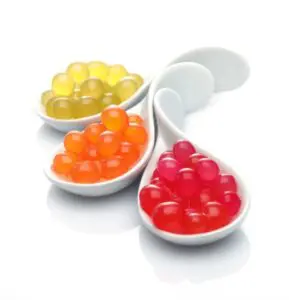
Popping boba, sometimes called popping pearls, are small juice-filled spheres used in bubble tea, frozen yogurt, smoothies, and desserts. Unlike traditional tapioca pearls, which are chewy and starch-based, popping boba has:
- A thin, gel-like outer skin
- A liquid center that bursts when you bite it
Commercial popping boba is usually made with:
- Water
- Sugar
- Fruit juice or flavored liquid
- Sodium alginate as a gelling agent
- A calcium salt such as calcium lactate or calcium chloride in a separate solution
The key technique behind popping boba is known as spherification. In simple terms, spherification uses a reaction between sodium alginate and calcium ions to build a thin gel membrane around a liquid.
The core science: how the gel shell forms
At the heart of a Popping Boba Machine is a reaction between sodium alginate and calcium ions.
- Sodium alginate in the flavor base
- Sodium alginate is a natural polysaccharide from brown seaweed.
- When you dissolve it into a juice or flavored liquid, it creates a slightly thicker solution.
- Calcium bath or calcium-rich core
- Calcium salts such as calcium chloride or calcium lactate provide calcium ions.
- When alginate and calcium meet, they cross-link and form calcium alginate, which is a soft, flexible gel.
- Droplets turn into “popping” beads
- When drops of the alginate mixture enter the calcium environment, the calcium ions start reacting at the surface of the drop.
- A thin gel membrane quickly forms around the outside, while the inside remains liquid.
- The result is a small sphere that can be handled, stored in syrup, and popped in the mouth.
In manual spherification, this might be done with a spoon or syringe. At industrial scale, the same science is applied inside a popping boba machine that controls each step much more precisely.
From lab test to popping boba machine: the process in simple steps
Whether you are running a benchtop trial or using a full Sinofude CBZ series popping boba machine, the basic sequence is similar.
1. Prepare the flavor base with alginate
- Mix fruit juice or flavored syrup with water, sugar, and sodium alginate.
Blend and let it rest so the alginate hydrates and no lumps remain.
See full boba making instructions here.
Why it matters:
Viscosity must be in a “sweet spot.”
- Too thin: droplets can flatten or deform in the bath.
Too thick: droplets do not form cleanly or can create tails.
2. Prepare the calcium environment
- Dissolve a calcium salt in water to create a calcium solution, or use a formulation where calcium is in the core and alginate is in the bath, depending on the method.
Why it matters:
If calcium is too low, the shell is weak.
If it is too high, the shell can become too thick or rubbery.
3. Form droplets
In a Popping Boba Machine:
- A pump pushes the flavored mixture into a depositing system.This is the part of the machine that turns a steady flow of liquid into many small, even drops.
- In Sinofude’s CBZ lines, the depositing system uses nozzles or a distribution plate with many small holes. As the liquid passes through, it breaks into uniform droplets that fall into the calcium bath and become popping boba.
Why it matters:
Droplet size determines bead diameter and influences shell formation time.
Uneven droplet size leads to uneven bite and appearance.
4. Gelation in the calcium zone
- Droplets fall into the calcium solution or pass through an alginate bath, depending on the configuration.
- Calcium and alginate meet at the surface and form a gel layer.
Why it matters:
Time in this zone controls how thick the membrane becomes.
Short time: shell may be too fragile.
Long time: the shell can continue to thicken and the center may start to feel less liquid.
5. Rinse and transfer into syrup
- The beads are lifted from the bath and rinsed in clean water to remove extra calcium or alginate.
- They are then transferred to a holding tank with flavored syrup, where they are stored until filling.
Why it matters:
Rinsing protects flavor and helps prevent off-tastes or saltiness.
Syrup protects structure and keeps the product ready for filling.
Where precision matters: common challenges for R&D
For R&D teams and product developers, popping boba looks simple from the outside, but several variables must line up to get a clean, stable bead.
Below are common issues and the levers that influence them.
1. Shell too thin or too thick
Problem:
- Shell breaks during pumping or filling
- Or the shell becomes thick and rubbery
Key variables:
- Alginate concentration in the flavor base
- Calcium concentration in the bath
- Residence time in the reaction zone
A controlled Popping Boba Machine lets you adjust flow rate, bath length, and temperature to keep the shell in the ideal range.
2. Irregular shape or tails
Problem:
- Beads look more like blobs or teardrops instead of near-spheres
Key variables:
- Thickness of the flavor base
- Height between depositor and bath
- Droplet formation method
For example, our CBZ500 line uses servo-driven depositing and distribution plates to standardize droplet formation and achieve uniform shapes in the 3 to 12 mm range, depending on the model and plate used.
3. Sticking and clumping
Problem:
- Beads stick together in the bath or syrup
- Clumps form that are unusable
Key variables:
- Overcrowded bath
- Inadequate agitation pattern
- Syrup solids and viscosity
Industrial lines use designed flow paths and agitation patterns to gently move beads without crashing them into one another.
4. Flavor fade or off-notes
Problem:
- Finished beads have less flavor than expected
- Slight bitterness or off-tastes appear
Key variables:
- Type and level of calcium salt
- Contact time before rinsing
- pH of the system and flavor base
For highly acidic flavors, some formulators use pH adjustment (for example, sodium citrate) to keep spherification performance stable. R&D teams often fine-tune this balance at a small scale before locking in the production recipe.
How a popping boba machine keeps the science under control
In a lab, a single person can adjust droppers, count seconds, and watch each bead. At scale, that is not realistic. A popping boba machine is designed to keep the critical science points stable during continuous production.
Sinofude’s CBZ series lines support this in several ways:
1. PLC (Programmable Logic Controller), and servo control
- PLCs, a servo drive that manages the heating, pump speeds, deposition timing, and conveyor or plate movement.
- Servo-driven systems (in models such as CBZ100S, CBZ200S, and CBZ500S) provide fine control over depositing and movement for consistent droplet size and spacing.
2. Distribution plates and nozzles
- Newer CBZ500 designs use distribution plates that allow many deposition holes per cycle and are easier to remove and clean than traditional nozzle banks.
- Plates can be swapped to change bead size or switch between popping boba and simulated caviar.
3. Integrated cooking and circulation systems
- Cooking systems heat and mix the flavor base and alginate solution so it stays uniform.
- Circulation systems keep calcium solution composition more stable over time and help manage fines.
4. Designed for multiple products
Many CBZ lines can produce not only popping boba, but also:
- Crystal boba
- Konjac balls
- Imitation caviar
by changing selected parts such as hoppers, cutting wires, or plates. This lets R&D teams explore line extensions without needing a new machine.
What R&D teams should focus on before scaling up
For beverage and dessert brands, a good approach is:
- Start small on the bench or lab machine
- Confirm target flavor, color, size, and bite.
- Dial in alginate concentration, calcium level, and pH.
- Move to a lab or pilot popping boba machine
- Lock in critical limits
- Define acceptable ranges for viscosity, temperature, bead diameter, and membrane strength.
- Capture these as part of internal specs and SOPs.
- Scale to CBZ100, CBZ200, or CBZ500
- Once performance is stable at pilot level, it is easier to move to larger automatic lines with confidence in the recipe and process window.
Turning popping boba science into a reliable process
Popping boba may look like a simple topping, but it depends on a very specific interaction between ingredients, process conditions, and equipment. When those are in sync, you get bright, round beads with a clean pop and consistent texture. When they are not, you get broken shells, off-textures, and waste.
A well-designed popping boba machine helps take what your R&D team has proven at the bench and repeat it hour after hour in production. With controlled depositing, stable calcium and alginate systems, and flexible settings, Sinofude’s CBZ series lines are built to support that balance.
If you are developing a new beverage or dessert concept or planning to bring popping boba production in house, our team would be happy to walk you through process options, pilot equipment, and full production lines.
Get a closer look at the tech behind the trend. Contact our team to discuss your popping boba formulation and see which popping boba machine best fits your next project.