
SUMMARY
Commercial candy making equipment is behind everything from gummy bears and popping boba to traditional hard candies and marshmallows. For food production professionals and candy entrepreneurs, it is essential to understand how these machines work together, including cookers, depositors, coolers, and packaging systems. This knowledge helps you build a reliable and scalable production line.
Being ready to scale your candy brand requires more than a great recipe. You also need the right commercial candy making equipment to turn that recipe into thousands of consistent, safe, and shelf-ready products every hour. Instead of small batch pots and hand-cut pieces, a modern production line relies on integrated machinery that mixes, cooks, forms, cools, finishes, and packages your products in a controlled way.
In this blog, we explain the major equipment used in large-scale candy production, what each machine does, and what you can expect as you plan or upgrade your manufacturing line.
Understanding the Commercial Candy Production Landscape
Commercial candy production is a step-by-step process that transforms raw ingredients into finished products at scale. To achieve consistent texture, flavor, and appearance, we rely on coordinated systems rather than standalone machines.
A typical setup for commercial candy making equipment may include:
- Mixing and dissolving systems that prepare the syrup or slurry.
- Cookers that bring the mixture to the correct temperature and solids level.
- Depositors or forming machines that shape the product.
- Cooling tunnels that set the candy structure.
- Finishing and coating equipment that adds polish, sugar, or chocolate.
- Weighing, counting, and packaging systems that create retail-ready products.
These components work together to support consistent output and compliance with hygiene and quality standards.
Core Types of Commercial Candy Making Equipment
1. Mixers and Cookers
Every candy product begins with a properly mixed and cooked base.
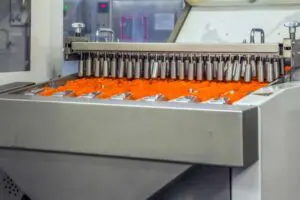
In our commercial candy making, industrial mixers and dissolvers combine sugar, glucose syrup, water, gelling agents, flavors, colors, and any active ingredients into a uniform mixture. Mixers play a key role in ensuring that ingredients are evenly distributed and that the texture remains consistent from batch to batch.
Cookers, which may be batch or continuous, heat this mixture to a precise temperature and target solids content. In many modern production lines, we use vacuum batch type cookers so that the mixture can reach the desired concentration at a lower boiling temperature. This helps protect heat-sensitive ingredients and maintain flavor and color quality.
What to expect from this equipment:
- Machines typically use food-grade stainless steel and are designed for hygienic operation.
- Controls allow you to set and monitor temperature, mixing speed, and time.
- Many systems are compatible with clean-in-place procedures that reduce downtime and support regular sanitation.
2. Depositors, Formers, and Cutters
Once the candy base is cooked, it needs to be shaped.
For gummies and similar products, a typical gummy production line from Sinofude includes a heated mixing kettle or vacuum cooker, a depositor, a cooling tunnel, a demolding device, a coating or polishing unit, and packaging machines.
Depositors accurately dispense the hot mixture into molds. In many cases, when customers talk about a “gummy machine,” they are referring to this depositor. It controls piece weight, shape, and in some cases multi-color or layered effects.
For hard candy, chews, or bars, some lines use extruders or rope formers with subsequent cutters instead of depositing into individual cavities. The mass is formed into a rope, calibrated, and then cut into pieces in a continuous flow.
These pieces of commercial candy making equipment determine the finished product’s size, shape, and many of its visual features.
3. Cooling and Setting Systems
After forming, the candy needs time and controlled conditions to set.
Cooling tunnels are specialized systems that move trays or molds through a series of zones with controlled temperature and airflow. For gummies and jellies, the cooling stage allows gelling agents to set and create the desired chew. For hard candies or bars, cooling stabilizes the glassy or semi-solid structure so products keep their shape.
A well-designed cooling system helps prevent sticking, deformation, and surface defects. It also supports consistent production speed.
- Finishing and Coating Equipment
Many candies go through a finishing step before packaging.
Common finishing equipment includes:
- Oiling or sugar sanding drums for gummies and jellies. These help prevent sticking and improve surface appearance.
- Panning systems that apply sugar or polish coatings to products like chocolate-coated nuts or button-shaped candies similar to M&M-style pieces.
- Chocolate enrobers that cover centers with a curtain of chocolate and create bars or chocolate-coated pieces.
This stage has a strong impact on brand perception because it affects how shiny, smooth, or colorful the final candy looks.
5. Counting, Weighing, and Packaging
The last major stage for commercial candy making is packaging.
Modern manufacturing lines often include:
- Multihead weighers or counting systems that ensure accurate weights or piece counts. This is particularly important for regulated or portion-controlled products.
- Form fill seal equipment that forms, fills, and seals pouches from roll stock.
- Cartoners and case packers that place pouches, bags, or trays into boxes and master cases for shipping.
Accurate and efficient packaging equipment helps reduce product giveaway and supports consistent presentation for retail distribution.
What to Do if You Are Planning or Upgrading a Candy Production Line
If you are exploring commercial candy making equipment for the first time, or if you want to modernize your current setup, the following steps can help guide your planning process.
1. Define your product mix and production targets
Decide which products are most important for your business. Examples include gummies, popping boba, hard candies, marshmallows, or caramels. Clarify your target throughput in kilograms per hour or pieces per hour. Industrial gummy manufacturing lines can range from a few thousand to more than 200,000 pieces per hour, depending on the configuration.
2. Map your process from raw materials to final packaging
Create a simple process map that covers ingredient handling, mixing, cooking, forming, cooling, finishing, and packing. This map will help you see where you need specific equipment and where automation could remove bottlenecks or manual steps.
When we work with customers, we often start by reviewing this type of process map together so that every stage of production has a clear equipment solution.
3. Prioritize hygiene, safety, and compliance
Choose equipment that uses food-grade materials and meets recognized management and quality standards. At Sinofude, we operate under the ISO9001 management system and most of our products carry EU CE and UL certifications.
Details like these matter when you are designing a line that needs to pass audits and maintain consistent hygiene from batch to batch.
4. Evaluate automation and control
Look at the level of automation offered for mixing, cooking, depositing, and packaging. PLC-based controls, recipe management systems, and clear operator interfaces can improve consistency, reduce training time, and make troubleshooting easier.
We design our systems with this in mind so that operators can run lines efficiently and make adjustments with confidence.
5. Work with an experienced equipment partner
Consider a manufacturer’s experience, product range, and ability to support you after installation. We supply gummy, candy, chocolate, and bakery equipment to clients in more than 60 countries and have more than three decades of experience in the field.
A knowledgeable partner can help you match equipment to your current needs while planning for future growth. Our goal is to help you build a line that supports both today’s products and tomorrow’s innovations.
Helpful Resources for Candy Manufacturers
When you research Commercial Candy Making Equipment, you may find it useful to review resources that go deeper into specific machines and applications. For example:
- Industry guides that explain different types of candy equipment and how they fit into a production line, such as our blogs “The Ultimate Guide to FAQs: Chocolate Bar Making Machine” and “Everything You Need To Know About A Gummy Making Machine”.
- Product-focused articles that walk through real line configurations and investment decisions, such as “When Is A Toffee Machine Worth The Investment?” and “Chocolate Machine: How It Can Make Your Life Better”.
Resources like these can support more informed conversations when you compare quotes, plan a new line, or speak with our sales and engineering teams about your specific project.
Sinofude Is Here to Help
At Sinofude, we focus on the production of gummy manufacturing equipment and other confectionery machinery and we have done so for more than 30 years. We supply machines and complete production lines for gummies, hard candy, chocolate, marshmallows, and related products.
By combining specialized engineering, quality-focused design, and global experience, we help food production professionals and candy entrepreneurs build commercial candy making equipment lines that support reliable output and consistent product quality.
To learn more about our solutions and discuss a line tailored to your products and capacity goals, you can visit our website and connect with our team.