
SUMMARY
Gummy candy consistency starts with the ingredients, but it depends on equipment control throughout the production process. In this blog, we break down what gummy candies are made of and explain how cooking, mixing, temperature control, depositing, and cooling affect texture, shape, and repeatability. We also cover common causes of soft sets, sticky gummies, and uneven texture, along with how the right equipment choices can help reduce defects.
What gummy candies are made of and how equipment controls consistency
For gummy producers, consistency is one of the most important measures of production success. A gummy candy should have the same texture, shape, weight, flavor, and appearance from one batch to the next. When it does not, production teams may face rework, waste, customer complaints, or delays in packaging.
The formula matters, but ingredients alone do not create consistency. Commercial gummy candy production also depends on the equipment used to cook, mix, deposit, cool, and handle the product. When equipment provides stable temperature control, uniform mixing, and repeatable depositing, manufacturers have a better chance of reducing defects and producing a predictable finished gummy.
At SINOFUDE, we design gummy candy production equipment to support the major stages of manufacturing, including syrup cooking, depositing, molding, cooling, de-molding, and final product output. SINOFUDE’s gummy production line solutions are built for candy manufacturers that need stable performance and consistent product quality at scale.
WHEN GUMMY MANUFACTURERS NEED AN INDUSTRIAL GUMMY MACHINE
What gummy candies are made of
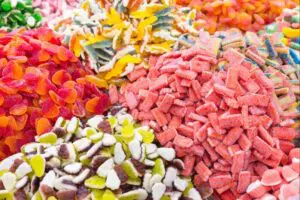
Most gummy candies are made from a combination of sweeteners, water, gelling agents, colors, flavors, acids, and sometimes coating ingredients. The exact formula depends on the product type, desired texture, target market, and production method.
A basic gummy candy formula often includes:
- Sweeteners, such as sugar, glucose syrup, or other syrup systems
- Water, which helps dissolve ingredients and control the cooking process
- Gelling agents, such as gelatin, pectin, carrageenan, agar, or starch systems
- Colors and flavors, which define the finished product’s appearance and taste
- Acids, such as citric acid or malic acid, which help create sourness and balance flavor
- Coatings, such as oil, wax, sugar, or sour sanding, depending on the product style
The relationship between these ingredients determines the gummy’s chew, firmness, clarity, sweetness, release from the mold, and shelf stability. For product developers and quality assurance teams, the goal is not only to choose the right ingredients. It is to make sure those ingredients behave consistently during production.
Why ingredients and equipment have to work together
A strong gummy formula still needs the right process conditions. If heating is uneven, mixing is incomplete, or depositing temperature changes during a run, the same recipe can produce different results.
For example, gelatin-based gummies and pectin-based gummies behave differently under heat, acid, and holding conditions. A formula that works well in a lab can perform differently on a production line if the equipment does not control temperature, residence time, mixing speed, or deposit volume properly. This is why equipment selection matters. Product developers may define the texture target, but production equipment determines whether that target can be repeated at commercial scale.
Cooking controls solids, viscosity, and final texture
Cooking is where the gummy base begins to develop its production behavior. Ingredients dissolve, water is reduced, and the syrup mass reaches the target concentration for depositing and setting.
During cooking, equipment must help control temperature and timing. If the gummy mass is undercooked, it may retain too much moisture and produce a softer set. If it is overcooked, the mass may become too thick, too firm, or difficult to deposit cleanly.
Cooking affects:
- Moisture level
- Solids concentration
- Viscosity
- Final chew
- Clarity
- Depositing performance
- Setting behavior
Stable cooking control is especially important for manufacturers running multiple formulas or higher-volume production. SINOFUDE CL80 gummy production equipment includes automated systems and PLC control options that support easier operation and more repeatable production control.
Mixing supports uniform flavor, color, acid, and active distribution
After cooking, the gummy mass needs to be mixed with ingredients such as flavors, colors, acids, and in some cases functional ingredients. This stage is critical because poor mixing can lead to uneven color, inconsistent flavor, texture variation, and quality issues.
Uniform mixing helps every deposit behave more like the one before it. For quality assurance teams, this is important because inconsistency can appear in several ways, including streaking, uneven sourness, weak gel formation, or finished gummies that feel different across the same batch.
Our CLM80 gummy candy equipment can include dosing systems for automatic injection of colors, flavors, and acids, which supports more automated operation and helps reduce variation from manual additions.
For manufacturers working with functional gummies, mixing control becomes even more important. Ingredients may have different sensitivities to heat, shear, or acid. The equipment must support accurate dosing and uniform distribution while protecting the product target.
WHY VITAMIN GUMMIES PLACE DIFFERENT DEMANDS ON A GUMMY LINE
Temperature control helps prevent production drift
Temperature changes can affect nearly every part of gummy production. If the mass cools too quickly before depositing, it may become too thick to flow properly. If it stays too hot for too long, it may affect the gelling system, flavor quality, or finished texture.
Temperature control matters during cooking, holding, transfer, mixing, depositing, and cooling. Each stage should support the next. If one point in the process drifts, the effects may show up later as weight variation, poor shape definition, soft sets, sticky surfaces, or demolding problems.
For process engineers, the key is to understand the full temperature path of the gummy mass. It is not enough to know the cooking temperature. Teams also need to monitor holding conditions, transfer lines, hopper temperatures, depositor conditions, mold temperature, and cooling time.
A stable temperature profile helps the gummy mass remain consistent from the first deposit to the last.
Depositing controls piece weight, shape, and repeatability
Depositing is where the gummy mass is portioned into molds. This stage directly affects finished piece weight, shape accuracy, appearance, and yield.
If depositing is inconsistent, production teams may see underfilled pieces, overflow, tails, bubbles, shape defects, or weight variation. These problems can lead to rejected product, extra inspection, and rework.
A good depositing system should support:
- Accurate portion control
- Stable deposit temperature
- Clean mold filling
- Repeatable shape definition
- Compatibility with different molds and formulas
- Consistent output across the production run
Our CLM80 automatic gummy production line uses a PLC control system and LED touch panel for operation, and it works with a specially designed demolding device and interchangeable molds to produce different gummy shapes.
This type of flexibility matters for producers that need to run multiple gummy formats without losing control over accuracy and repeatability.
Cooling and de-molding protect the finished structure
Once gummy candy is deposited, it needs time to cool and set. Cooling allows the gummy structure to stabilize before the product is removed from the mold.
If gummies are de-molded too early, they may stretch, tear, deform, or stick. If cooling is uneven, the same batch may produce gummies with different firmness levels. If the cooling stage is too slow, the line may lose efficiency.
Cooling affects:
- Firmness
- Shape retention
- Surface quality
- Mold release
- Production speed
- Downstream handling
De-molding also needs to be controlled. A gummy that releases cleanly is easier to inspect, coat, and package. A gummy that sticks or tears may create defects even if the cooking and depositing stages were correct.
For producers, cooling and de-molding should be considered part of the consistency strategy, not just the final steps before packaging.
Common causes of soft sets
A soft set happens when gummies do not firm up enough after cooling. This can make products difficult to demold, coat, package, or ship.
Common causes may include:
- Too much moisture remaining after cooking
- Incorrect gelling agent level
- Incomplete hydration or activation of the gelling system
- Poor temperature control
- Cooling time that is too short
- Formula changes that were not matched with process adjustments
- Acid timing or level issues, depending on the gel system
Equipment can help reduce soft sets by supporting more stable cooking, controlled mixing, consistent holding conditions, accurate dosing, and proper cooling time. The goal is to make sure the formula and process reach the same target conditions every run.
Common causes of sticky gummies
Sticky gummies can slow production and create packaging problems. They may cling to molds, stick to each other, pick up debris, or fail visual inspection.
Common causes may include:
- Excess moisture
- Incomplete setting
- Poor cooling conditions
- High humidity in the production environment
- Incorrect coating or polishing process
- Inconsistent cooking or drying
- Formula imbalance between sweeteners, water, and gelling agents
Sticky gummies are often a sign that the product has not reached the right balance of solids, moisture, and surface stability. Equipment that supports controlled cooking, stable cooling, and clean demolding can help reduce the risk.
Common causes of uneven texture
Uneven texture can appear as some gummies being too firm, too soft, grainy, rubbery, or inconsistent within the same batch. For quality teams, this can be one of the most frustrating problems because the issue may come from several stages of production.
Common causes may include:
- Uneven ingredient mixing
- Poor gelling agent dispersion
- Temperature variation during holding or transfer
- Inaccurate dosing of acids, flavors, colors, or actives
- Depositing at inconsistent temperatures
- Uneven cooling across molds or trays
- Delays between cooking, mixing, and depositing
This is where line integration becomes important. If cooking, mixing, depositing, cooling, and demolding are treated as separate steps with weak control between them, variation becomes harder to manage. A connected gummy production line helps manufacturers keep the process more stable.
How equipment choices reduce defects
Defect reduction starts with understanding where variation enters the process. For gummy candy, variation often comes from inconsistent temperature, poor mixing, inaccurate depositing, insufficient cooling, or weak coordination between machines.
When evaluating gummy production equipment, manufacturers should consider:
- Whether the cooker can maintain stable process conditions
- Whether mixing supports uniform distribution of ingredients
- Whether dosing systems can accurately add colors, flavors, acids, or actives
- Whether the depositor can control piece weight and shape
- Whether molds are compatible with the formula and release needs
- Whether cooling capacity matches output and product size
- Whether controls are easy for operators to monitor and adjust
- Whether the line can support future product formats
Our machines provide gummy candy production lines and related equipment for industrial-scale confectionery production, including systems designed to support different gummy shapes, colors, formulas, and production capacities.
Build consistency into the process
Gummy candy quality depends on more than a good formula. It depends on whether the production line can repeat the right conditions from batch to batch.
For product developers, that means designing formulas with production behavior in mind. For quality assurance teams, it means identifying which process points have the greatest impact on defects. For gummy producers, it means choosing equipment that supports consistent mixing, stable temperature control, accurate depositing, and reliable cooling.
At SINOFUDE, we help manufacturers understand how equipment choices affect gummy consistency and reduce defects. From ingredient handling to depositing and cooling, the right production line can help turn a formula into a repeatable commercial product.
Learn how equipment choices affect gummy consistency and reduce defects before planning your next gummy production line.