
SUMMARY
A gummy machine is not only a piece of hardware on your floor. It is one of the clearest indicators of where your business is in its growth journey. The right machine can help you test new formulas, launch a commercial line, expand into new markets, or supply large retail and nutraceutical partners. The wrong machine can hold you back with bottlenecks, overcomplicated setups, or unused capacity.
At Sinofude, we have spent more than 30 years focused on gummy manufacturing equipment and complete gummy production lines. We see the same pattern again and again. Brands grow in stages. At each stage, they need a different type of gummy machine, different throughput, and a different balance of flexibility and automation.
In this blog, we explain how gummy machines support growth from lab trials to industrial scale. We look at real capacity ranges, example Sinofude models, and what to consider as you move from one stage to the next so you can review how your production needs change as you grow.
Where a Gummy Machine Fits in Your Line
A modern gummy line has multiple parts. A gummy machine usually refers to the depositing and forming section, but in practice it is closely tied to upstream and downstream equipment:
- Jacket dissolving cooker and mixing system.
- Storage tank and pumps.
- Depositor and molds.
- Cooling tunnel.
- Demolding or de-panning.
- Oil or polishing unit, if required.
In Sinofude lines, a gummy machine sits inside a coordinated manufacturing system that can include automatic weighing, feeding, depositing, cooling, and even end of line packing, depending on the configuration.
Understanding where the machine sits in your process is the first step. The second step is choosing capacity and features that match where your business is today and where you want it to be in the next two to three years.
How Gummy Machines Match Different Stages of Growth
Instead of thinking about “small” and “big” gummy machines, it is more useful to think in stages.
Stage 1: R&D and Pilot Gummy Production Equipment
At this stage you are validating recipes, textures, and active ingredients. You need:
- Short changeover times.
- Very flexible settings.
- Equipment that fits in a lab, test kitchen, or innovation space.
Sinofude’s CLM Baby Gummy Machine is designed for this environment. It has a compact footprint, a 10 liter hopper, and up to 30 to 60 depositing times per minute. It is built for accuracy and reproducibility at small volumes and is suitable for small capacity production and trial work.
For slightly larger test runs, our Multifunctional Gummy Candy All in One Depositor Machine with Cooker can produce approximately 2,000 to 5,000 gummies per hour. It combines cooking and depositing in a single unit, which is ideal for controlled pilot runs and small specialty batches.
Stage 2: Small-Scale Commercial Gummy Manufacturing (CLM40/CLM80)
Once you have a product that sells consistently, you may move into:
- Supplying local stores or online orders.
- Producing regular but modest volumes.
- Running a few shifts per week rather than continuous production.
Here, compact lines like the CLM40 or CLM80 help bridge the gap.
- The CLM40 gummy production line runs at about 30 to 40 kilograms per hour and produces roughly 15,000 to 18,000 pieces per hour.
- The CLM80 compact gummy candy production line has a capacity of up to 80 kilograms per hour and is designed for small scale factories that need reliable but moderate output.
These systems are still manageable for small teams, but they introduce true continuous production and a professional depositing process.
Stage 3: Regional Growth with Mid-Range Gummy Lines (CLM150/CLM300)
At this stage, you may be:
- Supplying regional retailers or multiple private label partners.
- Producing vitamin, CBD, or functional gummies that require tighter controls.
- Running daily production schedules with planned changeovers.
Mid range lines such as the CLM150 and CLM300 become appropriate here.
- The CLM150 computerized gummy production system can produce up to about 60,000 gummies per hour with a capacity of 150 kilograms per hour. It is often used for CBD, THC, and vitamin gummies in one or two colors.
- The CLM300 automatic gummy production line offers around 300 kilograms per hour and supports different shapes through change over molds.
These gummy machines support more advanced features, such as recipe control, multi color options, and servo controlled depositing. They allow you to maintain consistent piece weights and textures at higher volumes.
Stage 4: Industrial Gummy Production and Contract Manufacturing (CLM600+
At the highest stage, you may:
- Supply national brands or global markets.
- Run multiple shifts and need high uptime.
- Operates as a contract manufacturer for several brands.
Large volume lines such as the CLM600 or higher capacity automatic depositing systems become the standard.
- The CLM600 gummy candy production line can produce up to 600 kilograms per hour and about 240,000 gummies per hour, with automatic weighing and feeding to reduce labor and improve efficiency.
At this level, your gummy machine is not just a depositor. It is the heart of a highly automated line that connects with upstream cooking, inline flavor and color dosing, and downstream cooling and packing.
How Different Types of Gummy Machines Work
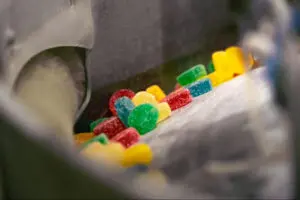
Although details vary, most Sinofude gummy machines follow a similar principle:
- A cooker or dissolving system prepares the gummy mass.
- Pumps move the mass to a heated hopper and distribution system.
- The depositor fills molds or trays using piston or servo driven nozzles.
- Molds travel through a cooling tunnel until gummies set.
- Gummies are demolded and sent to oiling, sugar coating, or packing.
Different models use this principle at different scales:
- Compact and baby gummy machines focus on flexibility and easy cleaning.
- Mid range CLM lines integrate PLC control and touch screen interfaces for better process control and recipe management.
- Large CLM600 type systems emphasize automatic feeding, high capacity depositing, and stronger integration with plant utilities and upstream systems.
The key is to choose a gummy machine whose operating mode and complexity match your team’s experience and your quality requirements.
Key Features to Consider at Each Stage
When you evaluate a gummy machine, think about stage specific needs rather than a long list of generic features.
For R&D and pilot work:
- Wide range of depositing weights and small minimum batch sizes.
- Simple changeover and cleaning.
- Ability to test different shapes, colors, and active ingredients quickly.
For first commercial production:
- Reliable basic automation with limited operator steps.
- Stable output in the tens of kilograms per hour range.
- Mold flexibility for seasonal or custom shapes.
For regional growth and functional products:
- Inline dosing of flavors, colors, and acids.
- Two color or filled gummy capabilities.
- PLC based control with recipe storage and alarms.
For industrial and contract manufacturing:
- High capacity (hundreds of kilograms per hour).
- Automatic weighing and feeding systems to reduce manual handling.
- Integration with cooling, packing, and plant data systems.
Practical Steps for Choosing the Right Gummy Machine
If you are reviewing how your production needs change as you grow, these steps can help.
- Write down your current and target outputs.
Include kilograms per hour and gummies per hour, as well as hours per day or shifts per week. Compare those values with the published capacities of different machines like the CLM40, CLM80, CLM150, CLM300, and CLM600. - List your product types and formats.
Note if you produce single color gummies, two color gummies, filled pieces, or 2D and 3D shapes. This will narrow your choice to models that support these features. - Evaluate your space and utilities.
Consider the length of line you can install, the available electrical capacity, and compressed air and cooling requirements. Sinofude specifications show typical line lengths and utility needs for each model. - Plan for at least one stage ahead.
If you are at Stage 2 now, consider whether you expect to reach Stage 3 within the next two to three years. Choosing a Gummy Machine that can handle some growth can reduce the need for very frequent upgrades. - Discuss your roadmap with an equipment partner.
Share your capacity targets, product roadmap, and timeline. This allows us to recommend a combination of machines that cover your current stage and provide a path to the next one.
How Sinofude Supports Business Growth at Every Stage
Sinofude focuses on gummy machines and complete gummy manufacturing equipment. Our range covers:
- Lab and small capacity solutions like the CLM baby gummy machine and multifunctional all in one depositor.
- Compact production lines such as CLM40 and CLM80 for small factories.
- Mid range and high capacity CLM150, CLM300, and CLM600 lines for growing and industrial manufacturers.
We combine this equipment range with more than 30 years of experience, ISO9001 based management, and global export experience across more than 60 countries.
Our goal is to help you choose a gummy machine that fits your current stage and gives you a clear path to the next one, instead of pushing you into a single oversized solution.
Review how your production needs change as you grow. If you are exploring gummy machines for a new line or planning an upgrade, you can contact the Sinofude team through our website to discuss your products, your capacity goals, and the stage you want to reach next.