
SUMMARY
Depositing gets most of the attention on a gummy line, but the real “make or break” stage often happens after the shot lands in the mold. Cooling, setting, and de-molding control whether gummies keep their shape, release cleanly, and stay non-sticky in handling and packaging. In this blog, we break down the gummy production process after depositing, what to watch in your cooling tunnel or curing area, how dwell time affects set, why humidity control matters, and how to time de-molding for cleaner release and better surface finish.
What Happens After Depositing: Cooling, Setting, And De-molding Gummies
If your gummies look great at the depositor but come out dull, sticky, misshapen, or hard to release, the cause is often not the depositor at all. It’s what happens next.
After depositing, gummies go through a “set” phase where structure forms and moisture starts to redistribute. In starch mogul systems, moisture also moves into the starch bed. In starch-less systems, the environment (airflow, temperature, and humidity) does more of the work.
Either way, this stage is where gummies become stable enough to handle.
To keep it simple: cooling and setting control shape, and controlled moisture loss controls stickiness. When either one drifts, de-molding becomes a fight and product consistency suffers.
You may also want to read our related blog on scaling without losing quality:
LAB TO LINE: HOW TO SCALE GUMMIES WITHOUT LOSING QUALITY
Why this stage gets overlooked (and why it causes so many defects)
Production teams often focus on cooking and depositing because those steps feel “active.” Cooling and curing can feel passive, like you just wait.
But in reality, this is a controlled process step with real variables:
- Temperature (how fast the gel sets and how the surface forms)
- Dwell time (how long pieces stay in that environment)
- Humidity (how much moisture gummies lose, or absorb)
- Release timing (whether gummies are strong enough to de-mold without damage)
Manufacturers who run starch moguls often move de-molded pieces into drying tunnels where moisture is reduced using a recipe-dependent profile of time, temperature, and airflow.
That same idea applies to many gummy lines: the drying and setting profile is part of the recipe.
Stage 1: Cooling (where shape gets “locked in”)
Right after deposit, gummies are still warm and soft. Cooling stabilizes the shape so it doesn’t slump, spread, or distort.
Many lines use a cooling tunnel or controlled cooling zone to bring temperature down evenly across the tray or belt. If cooling is uneven, gummies can set unevenly. That leads to shape variation and surface marks that show up later.
What to control in cooling
Airflow needs to be consistent. If one side of the tunnel gets more airflow, that side sets faster. Faster setting can create a firmer skin early, while the center is still soft. This is a common cause of uneven tops and release issues.
Temperature should change gradually. Over-aggressive cooling can shock the surface and create cosmetic defects. Cooling should stabilize shape first, then transition into controlled setting/drying.
Dwell time matters. Dwell time is simply how long the product stays in the cooling zone. If dwell time is too short, gummies may look set but still deform during handling. If it’s too long (or too cold), you can create release problems and a surface that doesn’t finish well.
Stage 2: Setting and curing (where texture and surface finish develop)
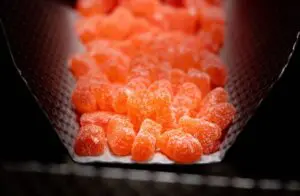
Setting is when the gel network finishes forming and the gummy becomes self-supporting. Curing is the stabilization period where moisture equalizes inside the piece and the surface becomes less tacky.
In starch mogul production, once deposited, trays are transferred into conditioning rooms where temperature, relative humidity, and residence time (how long they stay there) initiate curing. This stage is described as critical for moisture migration and structure formation that supports final texture and shelf life.
Even if you don’t use starch trays, the takeaway is the same: this stage controls moisture movement and structure.
Why humidity control is a big deal
Relative humidity (RH), which means “relative humidity”, describes how much moisture is in the air compared to what the air can hold at that temperature.
Gummies are hygroscopic, meaning they can absorb moisture from the air. If RH is too high, gummies can pick up moisture and become sticky.
If RH is too low in drying, you can get “case hardening,” where the outside dries too fast and traps moisture inside.
This is why steady humidity is not just an energy or comfort issue in the plant. It directly impacts product release and packaging performance.
What “good setting” looks like in production
When setting conditions are stable, you typically see:
- Cleaner edges and better definition
- Less surface tack at demold
- More consistent weight and texture across the batch
- Fewer finishing problems (like uneven sanding or oily patches)
If you’re building a new line or changing equipment, read our blog:
GUMMY MAKING MACHINE: QUESTIONS TO ASK BEFORE YOU BUY
Stage 3: De-molding (where small timing mistakes create big waste)
De-molding is not just “removing gummies from molds.” It’s a timing decision.
De-mold too early, and pieces can:
- Stretch or tear
- Deform and lose shape
- Stick to molds and rip at release
- Leave rough surfaces that are hard to finish
De-mold too late, and you may see:
- Harder release due to surface drying
- More breakage on certain shapes
- Slow throughput and backup in the line
The real goal: release when the surface is stable, not just “cool”
A gummy can be cool enough to touch and still be too soft inside. A better demold rule is: the piece should hold its shape during handling without sticking or stretching.
If you’re running starch molding, the starch condition also plays a role because it affects how moisture is pulled from the surface during setting. (When starch is too wet, it absorbs less moisture and can contribute to sticky results.)
The most common “after depositing” problems and what to adjust
Gummies deform or slump
This is usually a cooling and early-setting issue.
- Increase cooling stability (even airflow and steady tunnel temperature)
- Confirm dwell time is long enough for shape to hold before movement
- Check if deposit temperature is too high for the mold/set stage
Gummies are sticky at de-mold
This usually points to moisture and humidity control.
- Confirm RH stability in the set/dry area (high RH can lead to tack)
- Avoid overly fast surface drying that traps moisture inside (case hardening)
- If using starch, confirm starch condition supports moisture control
Gummies release but look dull or rough
This often comes from uneven setting or surface drying.
- Check airflow patterns (hot spots and dead zones)
- Check dwell time consistency across shifts
- Review de-mold timing and mold condition (release surfaces must be clean and consistent)
Release varies by tray or by side of the line
That usually means conditions are not uniform.
- Compare left/right tunnel temperatures and airflow
- Confirm humidity distribution is even
- Verify tray loading patterns are consistent (overcrowding changes airflow)
Operator-friendly checkpoints for stabilizing cooling and setting
If you want fewer surprises, keep the checks simple and repeatable:
- Log tunnel/room temperature and RH on a schedule
If you don’t trend it, you can’t control it. Small drifts create big product changes over hours. - Standardize dwell time
Dwell time should not change just because a shift is busy. Build it into the rhythm of the line. - Watch release behavior as a process signal
If gummies suddenly stick more, treat that as an early warning that conditions have changed. Don’t just “muscle through” de-molding. - Check a tray map, not just one tray
Pull samples from front/middle/back and left/right. Many “mystery” issues are really airflow or humidity distribution problems.
How Sinofude can help
Cooling, setting, and de-molding problems usually come from unstable conditions, not “bad gummies.” Sinofude helps manufacturers tighten the post-deposit stage of the gummy production process by matching cooling and curing strategy to your product, throughput, and plant environment. If your line struggles with stickiness, inconsistent release, or cosmetic defects, we can help you identify the control points that stabilize results and improve yield.