
SUMMARY
Waste in candy gummies production often comes from small process problems that repeat across cooking, depositing, cooling, and startup. In this blog, we share practical ways candy manufacturers, operations managers, and process engineers can reduce waste by controlling startup scrap, weight variation, temperature drift, inconsistent cooling, and rework. We also explain how repeatable settings and the right equipment support more consistent output across the line.
Practical Ways to Reduce Waste in Candy Production
Waste in candy production is not always caused by one major failure. In many cases, it comes from small inconsistencies that happen across the line every day. A batch may start with too much startup scrap. A depositor may create weight variation. A holding tank may drift in temperature. A cooling tunnel may not set products evenly. Over time, these issues can lead to rework, rejected product, extra labor, and higher production costs.
For candy gummies manufacturers, waste reduction starts with understanding where variation enters the process. Cooking, depositing, cooling, demolding, and finishing all affect final quality. When settings are repeatable and equipment is matched to the product, teams can reduce defects and make better use of ingredients, labor, and production time.
Our gummy production equipment here at SINOFUDE is designed to support key production stages such as cooking, storage, depositing, molding, cooling, and control systems, helping manufacturers build a more consistent gummy process.
GUMMY CANDY PRODUCTION PROCESS FOR MANUFACTURERS
Where waste often starts in candy gummies production
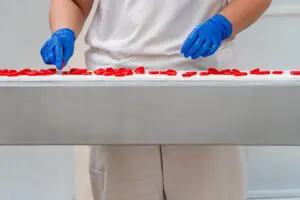
Waste can appear at the end of the line, but it often starts much earlier. If the syrup is not cooked consistently, the depositing stage may struggle. If the gummy mass temperature shifts during holding, the product may not fill molds the same way. If cooling is uneven, gummies may stick, deform, or fail inspection.
Common sources of waste include:
- Startup scrap while the line reaches stable conditions
- Product weight variation from inconsistent depositing
- Temperature drift during cooking, transfer, or holding
- Air bubbles, tails, strings, or incomplete mold fill
- Gummies that are too soft or too firm after cooling
- Sticking, tearing, or deformation during demolding
- Rework caused by inconsistent texture, shape, or finish
Reducing waste means looking at the whole process, not only the rejected product. A finished gummy that fails inspection may be the result of a problem that started several steps earlier.
Reduce startup scrap with documented settings
Startup scrap is common in candy production, but it should not be accepted without review. During startup, the line may need time to reach the correct temperature, flow, deposit weight, mold timing, and cooling conditions. If operators are adjusting by feel each time, the amount of scrap can vary from shift to shift.
A better approach is to document startup settings for each product. This includes cooking temperature, holding temperature, depositor settings, mold setup, cooling time, and inspection checkpoints. The goal is to help operators reach stable production faster and with fewer rejected pieces.
Useful startup checks include:
- Confirming recipe and ingredient preparation
- Verifying cooking and holding temperatures
- Checking depositor nozzle alignment
- Testing deposit weight before full-speed production
- Confirming mold indexing and fill quality
- Reviewing cooling tunnel conditions before release
Repeatable startup settings help reduce trial-and-error adjustments. They also make it easier to train operators and compare performance across shifts.
Control temperature drift before it creates defects
Temperature control is one of the most important factors in candy gummies production. If the gummy mass becomes too cool, it may thicken and create poor mold fill, strings, or inconsistent piece weights. If it remains too hot for too long, texture, flavor, or setting behavior may shift.
Temperature drift can happen during cooking, transfer, holding, mixing, or depositing. A small change may not seem serious at first, but it can affect viscosity and deposit accuracy.
Process teams should monitor:
- Cooking temperature
- Holding tank temperature
- Transfer line temperature
- Depositor hopper temperature
- Product temperature before cooling
- Product temperature before demolding
FDA Current Good Manufacturing Practices for food address production and process controls, plant equipment, sanitary operations, and maintenance, which reinforces the importance of controlled and well-maintained production systems.
Tighten depositor control to reduce weight variation
Depositing has a direct effect on waste because it controls piece weight, shape, and mold fill. If deposit weights vary, some pieces may be underweight, overweight, misshapen, or difficult to cool evenly. Even small variations can become expensive when multiplied across thousands of pieces per hour.
Operations teams should monitor deposit weight regularly during production, not only at startup. They should also check nozzle cut-off, hopper level, product temperature, deposit speed, and mold alignment.
Weight variation may come from:
- Unstable gummy mass viscosity
- Incorrect depositor settings
- Worn or misaligned nozzles
- Temperature changes in the hopper
- Inconsistent mold indexing
- Air in the product stream
For candy gummies, consistent depositing also supports downstream performance. Pieces with similar weight and shape cool more predictably, demold more cleanly, and are easier to coat or package consistently.
GUMMY BEAR CANDY MANUFACTURING: WHAT CHANGES WITH SHAPED GUMMIES
Improve cooling consistency to reduce rework
Cooling is where the gummy structure becomes stable enough for handling, demolding, coating, or packaging. If cooling is inconsistent, finished gummies may vary in texture, stick to molds, deform during release, or fail quality checks.
Cooling problems often show up as product defects, but the cause may be airflow, dwell time, tunnel temperature, humidity, mold loading, or product weight variation. If some gummies cool faster than others, the final batch may not behave consistently.
Teams should review:
- Cooling dwell time
- Cooling tunnel temperature
- Airflow patterns
- Humidity levels
- Mold spacing and loading
- Product temperature before demolding
- Texture after holding
Our gummy equipment includes systems such as cookers, storage tanks, depositing machines, molds, and cooling tunnels, which are key areas for controlling production consistency. When cooling is stable and matched to the formula, manufacturers can reduce sticking, shape defects, and unnecessary rework.
Use inspection data to find repeat problems
Waste reduction should be measured. If teams only remove defective products without tracking the reason, the same issue is likely to return.
A simple waste log can help identify patterns by recording the product, shift, machine settings, defect type, location on the line, and corrective action. Over time, this can show whether waste is linked to startup, a specific depositor, a cooling zone, a mold set, or a particular formula.
Useful categories include:
- Startup scrap
- Weight variation
- Underfilled molds
- Overflow
- Sticking
- Texture defects
- Cooling issues
- Demolding damage
- Coating or finishing defects
The goal is not to create extra paperwork. The goal is to make waste visible enough to fix. When teams can connect defects to process conditions, equipment changes become easier to justify.
Standardize settings before increasing speed
Increasing line speed can make waste worse if the process is not already stable. A depositor that performs acceptably at a lower speed may create more variation at higher output. Cooling time may become too short. Demolding may happen before the gummy is ready. Operators may spend more time correcting problems than producing saleable product.
Before increasing speed, teams should confirm that the current process is repeatable. Stable weight, clean mold fill, consistent cooling, and reliable demolding should come first.
A practical question to ask is: Can the line run the current product consistently for a full production window with minimal adjustment? If not, speed may not be the first problem to solve.
Equipment changes that can reduce candy waste
Not every waste issue requires a full line replacement. Sometimes the right improvement is better temperature control, depositor maintenance, nozzle adjustment, improved mold compatibility, stronger cooling capacity, or better operator controls.
Equipment changes may be worth reviewing when waste is tied to:
- Frequent startup scrap
- Repeated weight variation
- Unstable holding or hopper temperatures
- Poor mold fill
- Inconsistent cooling
- Sticking during demolding
- Difficult cleaning or changeovers
- Too much manual adjustment
Our equipment provides candy and gummy production equipment designed for different production needs. The right equipment setup should help operators maintain consistent settings, reduce manual guesswork, and support repeatable quality.
Use this checklist to spot waste on your line
Reducing waste in candy gummies production starts with practical observation. Walk the line from cooking to cooling and look for where variation appears.
Ask these questions:
- How much product is lost during startup?
- Are startup settings documented for each product?
- Does the gummy mass temperature stay stable through holding and depositing?
- Are deposit weights consistent across cavities and over time?
- Are molds filling cleanly without bubbles, tails, or overflow?
- Is cooling dwell time long enough for clean demolding?
- Are defects tied to specific molds, nozzles, shifts, or formulas?
- Are operators making repeated manual adjustments?
- Is rework being tracked by defect type and cause?
At SINOFUDE, we help candy manufacturers evaluate how equipment and process control affect consistency across cooking, depositing, cooling, and finishing. Use this checklist to spot where equipment changes can reduce waste on your line and support more repeatable candy gummies production.