

SUMMARY
Rework quietly drains time, labor, and ingredients on candy lines, even when the product still feels close to spec. This blog explains how commercial candy making equipment like cookers, depositors, and coolers can reduce rework and waste through better process control, automation, and repeatable settings. You will also get a practical checklist to help identify where targeted equipment upgrades can stabilize your line and protect margins.
Commercial Candy Making Equipment and Why Rework Keeps Showing Up
Rework is any extra processing needed to bring a product back within specification so it can ship. It often looks small at the moment, but it adds up quickly because it consumes labor, capacity, and ingredients that should have gone into first pass production. Rework is also commonly treated as a quality loss in Overall Equipment Effectiveness (OEE) style tracking, alongside scrap.
Many candy manufacturers see rework when the process is not stable run to run. A batch cooks slightly hotter than normal. Deposits drift a few grams. Cooling conditions change across the belt. Each issue can be manageable alone, but together they create a pattern of adjustments, hold time, and product that needs to be reworked.
Commercial candy making equipment can reduce rework by making the process more consistent. The goal is simple. Produce the right candy the first time, more often, with fewer surprises.
Related read: LAB TO LINE: HOW TO SCALE GUMMIES WITHOUT LOSING QUALITY
Where rework starts on candy lines
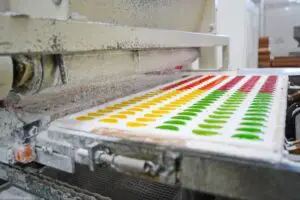
Most rework comes from a short list of repeat problems. These problems usually tie back to control, consistency, or handoffs between machines.
Variable cooking results
If cook temperature, cook time, or solids are not repeatable, texture and moisture can drift. That can lead to candy that does not set correctly, does not cut cleanly, or does not meet weight and density targets. When teams try to fix these issues downstream, rework increases.
Upgraded cookers and kitchen systems help by holding tighter process conditions and reducing operator guesswork. They also support repeatable recipes and setpoints, so your best run becomes easier to repeat.
Depositing drift and weight variation
Depositing is a major driver of giveaway, defects, and rework. When deposit weight drifts, you can end up with product outside target weight, uneven shape fill, or piece variation that complicates packaging.
High precision depositing systems are designed to improve weight control and shape definition for confectionery products.
In confectionery, even small weight inconsistencies can drive product giveaway or rework at scale, which is why real time weight control is increasingly emphasized by equipment and automation suppliers.
Upgraded depositors help reduce rework by delivering more consistent deposits and by making settings easier to repeat when you switch between products.
EXPLORE HIGH QUALITY CANDY MAKING MACHINES
Cooling problems that create defects later
Cooling is where many quality issues become visible. A candy can look acceptable right after forming, then fail later as it cools, sets, or is handled.
Cooling that is too fast or too slow can create cracking, sticking, deformation, or inconsistent bite. Environmental conditions like humidity can also affect texture and surface quality in confectionery processing environments.
Commercial coolers and controlled cooling systems reduce rework by creating stable conditions across the product path, not just in one spot on the line.
Related read: AFTER DEPOSITING GUMMIES: COOLING, SETTING, AND DE-MOLDING
How process control and automation cut rework without complexity
Many teams worry that process control and automation will make the line harder to run. In practice, the right upgrades usually make the line easier to run because the equipment carries more of the consistency burden.
Here is what matters most.
Repeatable settings that match real production
Rework increases when a line depends on manual adjustments to stay in spec. Equipment with recipe management and repeatable setpoints helps your team start closer to the target, then stay there longer.
This matters for cookers, depositors, and coolers. If the equipment can reliably return to known settings, you reduce variability between shifts and between runs.
Monitoring that catches drift before product is off spec
Rework often happens because the line drifts slowly until the product falls outside limits. Monitoring key variables helps teams catch drift earlier. That can include temperature stability, deposit weight trends, and cooling conditions.
When rework and scrap are treated as quality losses, improving control and detection is one of the fastest ways to raise first pass yield.
Automation that reduces operator dependency
Automation does not remove operators from the process. It reduces the need for constant manual correction. When the line is stable, operators can focus on verifying quality, managing changeovers, and responding to true exceptions.
The three equipment areas that most directly reduce rework
If you are prioritizing upgrades, these are the areas that usually produce the strongest rework reduction.
1. Cooker and kitchen upgrades
Look for equipment that supports consistent cook profiles, stable transfer, and predictable batch results. When the kitchen output is stable, the rest of the line has fewer problems to correct.
Kitchen stability also supports better scheduling. When batches are repeatable, you spend less time on trial adjustments that create off spec products.
2. Depositor upgrades
Depositing is often the most direct lever for reducing weight variation, shape defects, and overfill. Precision depositing systems emphasize accuracy and weight control, which helps reduce both giveaway and quality deviations.
If your line sees frequent adjustments at the depositor, or if packaging routinely flags weight or shape issues, this is a high impact area.
3. Cooling and environmental control upgrades
Cooling stability affects texture, shape retention, and handling. If defects appear after cooling, or if quality issues vary by season, cooling and environmental control may be the missing piece. Humidity control is often discussed as a key factor in confectionery facilities because it can affect product texture and process stability.
Checklist to spot where upgraded candy making equipment can reduce rework
Use this checklist on your current line. It helps you pinpoint the stage that creates the most rework, not just the stage where rework gets noticed.
Cooker and kitchen
- Batch results vary between shifts even when the recipe is the same
- Operators routinely adjust cook time or temperature to hit texture targets
- You see frequent hold time that affects flow to forming or depositing
- Finished texture varies by batch in ways you cannot explain quickly
Depositing and forming
- Deposit weights drift over the run and require frequent correction
- You see frequent overfill, underfill, or inconsistent shape definition
- Packaging flags weight variability or piece size inconsistency
- Changeovers create a long period of product that needs rework
- You see giveaway that feels like a safety buffer, not a controlled decision
Precision and weight control improvements are commonly linked to reduced giveaway and waste in depositing and portioning processes.
Cooling and downstream handling
- Defects show up after cooling, not immediately after forming
- Texture changes across seasons or during high humidity periods
- Sticking, cracking, or deformation increases at higher line speeds
- Product handling is inconsistent during demolding, conveying, or packaging feed
- You slow the line because cooling time is not predictable
Humidity and facility conditions can affect confectionery quality and stability, which can increase rework when not controlled.
How Sinofude helps teams reduce rework with the right equipment choices
At Sinofude, we help candy manufacturers evaluate commercial candy making equipment through the lens of rework reduction. That means looking at the full process, not just one machine. We focus on cooker stability, depositing accuracy, cooling consistency, and the controls that make results repeatable.
If your team is seeing frequent adjustments, variable output, or product that needs extra handling to meet spec, we can help you identify the most practical upgrade path. The best upgrades are the ones that make the line easier to run and more consistent day after day.
Use this checklist to spot where upgraded candy making equipment can reduce rework on your line.