

SUMMARY
In 2026, calling yourself a gummy manufacturer means more than owning a depositor and running batches. Modern gummy manufacturing is defined by scalable equipment, repeatable quality, strong hygiene controls, and the ability to flex recipes, formats, and packaging requirements without losing consistency. In this blog, we break down what separates small-batch producers from full-scale manufacturers, and how to evaluate whether your current setup is truly ready to scale.
What it really means to be a modern gummy manufacturer in 2026
The term gummy manufacturer gets used in a lot of ways. Sometimes it describes a brand that runs small batches in-house. Sometimes it refers to a full-scale facility producing millions of pieces a day across multiple Stock Keeping Unit (SKUs). The difference matters, especially when you are planning growth, tightening quality expectations, or preparing for larger retail and distribution requirements.
A modern gummy manufacturer is not defined by one machine. It is defined by the ability to produce gummies that are consistent, safe, and scalable, even as recipes and demand change.
This is what gummy manufacturer really means in 2026, and how to see where your line fits.
You may also want to read:
LAB TO LINE: HOW TO SCALE GUMMIES WITHOUT LOSING QUALITY
A modern gummy manufacturer is built for repeatability, not just output
Many lines can make gummies. Modern manufacturers make gummies that match the same standard every day, across shifts, across seasons, and across new product launches.
That repeatability comes from control. It also comes from equipment that supports process stability instead of forcing operators to “muscle through” variation.
In practical terms, a modern setup should support consistent control of:
- Cooking and solids content
- Deposit temperature and weight accuracy
- Cooling, setting, and humidity conditions
- Demolding and finishing consistency
- Packaging flow without stickiness, clumping, or shape damage
When those variables drift, the brand pays for it through waste, rework, downtime, and customer complaints. A modern gummy manufacturer builds a process that reduces the chance of drift in the first place.
Related read: WHY GUMMY DEPOSIT ACCURACY MATTERS AND HOW TO IMPROVE IT
Equipment capability matters, but flexibility matters more
Founders often ask, “What machine do I need?” Production leads usually ask a different question: “What will this machine let us do next year?”
A modern gummy manufacturer invests in equipment that can handle growth without trapping the business in a narrow product lane. That means thinking beyond today’s hero SKU.
Here are the capability areas that usually separate small-batch lines from scalable manufacturing lines.
Depositing that stays accurate at production speed
A depositor that hits target weight and shape at low speed is a start. A modern manufacturer needs weight accuracy and clean definition at throughput. This matters for cost control, compliance targets, and customer experience.
Cooling and setting systems designed as part of the recipe
Cooling and curing are not passive steps. They are process steps. Your cooling tunnel or conditioning area should be designed for even airflow and stable conditions, so pieces are set consistently across trays or belts.
Brands that struggle with dull surfaces, sticky release, or shape inconsistency often find the root cause here.
Related read: AFTER DEPOSITING GUMMIES: COOLING, SETTING, AND DEMOLDING
Changeover that does not destroy your schedule
Modern gummy manufacturing is rarely one product, one mold, one recipe. Changeovers matter. A scalable line is designed to reduce downtime between SKUs, and to make sanitation and revalidation realistic for a busy production calendar.
Recipe flexibility is part of the job description now
In 2026, the market expects variety. Brands want new textures, claims, and formats. Retail and distribution partners also expect consistent performance in shipping, shelf life, and packaging.
A modern gummy manufacturer needs to support real formulation flexibility, including:
- Gelatin and pectin systems
- Different acid and flavor strategies
- Higher actives, where feasible
- Different piece sizes, shapes, and finishes
- Packaging requirements that demand lower tack and better stability
This is where small-batch production often hits a wall. A recipe may work beautifully at bench scale, then fail during scale-up due to cooking control, deposit behavior, or moisture and humidity dynamics after depositing.
Scaling requires process control, not just recipe adjustment.
Hygiene standards are not optional at scale
A modern gummy manufacturer is expected to operate with strong sanitation and contamination prevention practices, even when gummies feel “low risk” compared to other foods.
In the United States, FDA Current Good Manufacturing Practices for food address areas like plant and equipment design, sanitary operations, hygiene, and process controls.
For facilities making human food, FDA regulations in 21 CFR Part 117 include CGMP requirements and preventive controls frameworks. For dietary supplements, 21 CFR Part 111 covers supplement CGMP requirements. Official text is available via the eCFR:
Even when you are not operating as a supplement facility, the takeaway is simple. A modern gummy manufacturer designs the process so it can be cleaned, verified, and repeated without constant risk of contamination or variability.
Hygienic design is part of that conversation. Industry organizations like EHEDG hygienic design principles focus on equipment and facility design that supports effective cleaning and reduces contamination risk.
On the management system side, many manufacturers also align with structured food safety systems such as ISO 22000 overview.
These standards do not replace practical plant discipline. They support it.
The real difference between small-batch producers and full-scale manufacturers
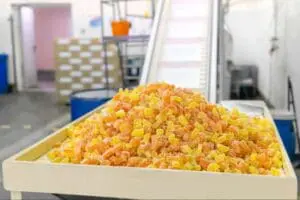
Small-batch producers often succeed through craftsmanship and attention. Full-scale manufacturers succeed through systems.
Here is the simplest way to compare the two.
Small-batch producers often rely on people to hold the process together
A strong operator can make a small line run well. In many early-stage setups, the line depends on experience, manual judgment, and workarounds. That can work for limited throughput.
Full-scale manufacturers rely on controls, design, and repeatable procedures
At scale, consistency has to survive shift changes, new hires, new SKUs, and variable plant conditions. That requires equipment designed for stability and processes designed for repeatability.
If your quality depends on one person being present, the setup is not truly scalable.
A simple checklist to see where your setup stands
If you want a quick reality check, start here:
- Can you run at production speed and still hit target weight and shape?
- Are cooling, curing, and humidity controlled, documented, and stable?
- Do you have a predictable sanitation approach that fits your schedule?
- Can you change recipes or formats without weeks of rework and waste?
- Does your packaging step run smoothly without stickiness and clumping?
A modern gummy manufacturer can answer yes to most of these consistently, not just on a good day.
How Sinofude can help
Modern gummy manufacturing is a system, not a single piece of equipment. Sinofude helps brands and production teams evaluate where their current gummy line is strong, where it is vulnerable, and what upgrades or process changes will support true scale.
If you want to see how your current setup compares to a modern, scalable gummy manufacturer, our team can help you identify the control points that matter most and map the smartest path forward.
See how your current setup compares to a modern, scalable gummy manufacturer.