
SUMMARY
As a growing brand, one of the biggest strategic calls you will make is whether to build in-house capability or outsource to a gummy manufacturer. This blog breaks down the real tradeoffs in 2026, including equipment investment, process control, product flexibility, compliance expectations, and long-term cost structure. Use this comparison to decide whether your next step is building your own line or partnering with a manufacturing team.
Build or outsource? Gummy manufacturer pros and cons in 2026
Every growing gummy brand hits the same crossroads.
You have demand. You have new Stock Keeping Unit (SKUs) in the pipeline. Your team is tired of being limited by small runs, long lead times, or quality drift. Then the big question shows up.
Do we build our own operation, or do we partner with a gummy manufacturer?
There is no universal right answer. There is only the answer that matches your growth plan, risk tolerance, capital strategy, and timeline. What matters is seeing the full picture before you commit, because the wrong choice usually looks fine for six months and painful for the next two years.
This guide lays out the real pros and cons of both options, with a focus on the factors that matter most for modern gummy production.
Related read: LAB TO LINE: HOW TO SCALE GUMMIES WITHOUT LOSING QUALITY
Option 1: Building in-house gummy manufacturing
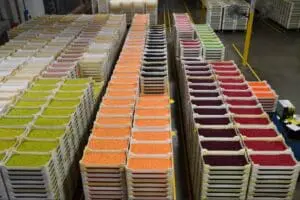
Building in-house can be the right move when control is the priority and your volume path is clear. It can also become a costly distraction if the plan is not grounded in throughput reality and operational capacity.
Pros of building in-house
You control the process.
Owning the line means your team controls cooking, depositing, setting, finishing, and packaging decisions. That matters when you have tight texture requirements, a sensitive formulation, or a strong need to iterate quickly.
You can protect product details.
Brands with unique formulations often prefer in-house production because it reduces exposure and keeps operational knowledge internal.
Your unit economics can improve at scale.
When a line is well utilized and stable, in-house production can reduce per-unit costs over time. The catch is that this usually requires steady demand and disciplined scheduling. A half-used line is not a margin advantage.
You build a long-term asset.
A properly designed facility becomes an engine for future launches. You can expand shifts, add formats, and build internal expertise that compounds over time.
Cons of building in-house
Capital spend shows up faster than most teams expect.
It is not only the depositor. It is also cooking, cooling, curing or conditioning space, air handling, humidity control, demolding, finishing, packaging, QA tools, and utilities. It is the facility layout and the time it takes to validate the process.
Process control becomes your responsibility.
A modern gummy manufacturer is defined by repeatability. That means controlling variables like deposit accuracy, cooling and curing stability, and humidity. If those controls are not stable, you will spend a lot of time chasing stickiness, texture drift, release issues, and packaging problems.
Related read: AFTER DEPOSITING GUMMIES: COOLING, SETTING, AND DEMOLDING
Hiring and training becomes a critical path.
Even excellent equipment will not fix a team that is learning on the fly without enough technical leadership. Many brands underestimate how much daily output depends on operators, sanitation discipline, and consistent procedures.
Compliance expectations still apply.
If your gummies are dietary supplements, U.S. dietary supplement CGMP requirements are covered under 21 CFR Part 111, which applies to companies that manufacture, package, label, or hold dietary supplements. FDA also provides CGMP information for food and dietary supplements that highlights sanitation, facility design, and production controls. Even when you outsource, quality accountability stays with the brand. When you build in-house, the systems to meet those expectations are on you from day one.
Option 2: Outsourcing to a gummy manufacturer
Outsourcing can be the fastest way to scale, especially when speed to market and predictable quality are priorities. It can also introduce tradeoffs in flexibility and scheduling.
Pros of outsourcing
Faster path to production scale.
A capable gummy manufacturer already has validated equipment, trained teams, and established quality systems. You avoid the long ramp of building and debugging a new line.
Lower upfront investment.
Instead of paying for a facility and full process stack, you pay per batch or per unit. This is often the most practical move when demand is still scaling and the brand wants to conserve capital.
Built-in expertise and problem-solving capacity.
Established manufacturers have likely seen the issues that newer brands struggle with. That includes texture drift, sticky packaging, inconsistent finish, or stability challenges that show up in shipping.
Easier to expand formats or capacity.
If you need to move from one SKU to five, or from one shift to three, a larger partner can often scale faster than a brand building from scratch.
Cons of outsourcing
You trade some control for capacity.
Even great partners run standardized systems. Your product must fit their process windows, not the other way around. Complex formulas or unusual processing requirements can be harder to run consistently.
Scheduling and lead times can limit agility.
You can be limited by minimum order quantities, production calendars, and changeover schedules. When you want a fast change, you might be one priority among many.
Your differentiation can be harder to maintain.
If your brand wins through unique texture, rapid iteration, or constant R&D, outsourcing can slow you down unless the partner is built for true customization.
The decision usually comes down to four factors
Most brands can simplify the build versus outsource decision by focusing on these four areas.
1. Equipment investment and facility readiness
If you build, you are buying a system, not a machine. The production line includes upstream cooking and mixing, downstream setting and moisture control, finishing, and packaging. It also includes utilities, hygiene design, and process documentation.
If you outsource, the question becomes how much capital you want to keep available for marketing, retail growth, staffing, or other strategic priorities.
2. Process control and repeatability
If your product requires tight texture and finish consistency, ask how you will control the variables that drive drift. That includes deposit accuracy, cooling and curing conditions, and humidity stability after depositing.
Related read: WHY GUMMY DEPOSIT ACCURACY MATTERS AND HOW TO IMPROVE IT
A modern gummy manufacturer runs with repeatable controls across shifts. If your plan depends on operator heroics, it is not a scalable plan.
3. Product flexibility and future pipeline
In 2026, brands rarely stay in one lane. New flavors, new active ingredients, new piece shapes, new finishes, and new packaging types show up quickly.
If your pipeline is aggressive and fast-moving, in-house production can support iteration. If your pipeline is steady and volume-driven, outsourcing can give you scale without distraction.
4. Long-term cost structure
In-house can win on unit cost when the line is well utilized and stable. Outsourcing can win on total cost when it avoids wasted capital, downtime, and learning curve losses.
The real cost question is not only dollars per unit. It is the cost of delay, waste, and quality failures. Those costs show up later, and they hurt more.
How Sinofude can help
This decision is easier when you can see your current setup clearly. Sinofude helps gummy brands evaluate whether their current line is operating like a modern, scalable gummy manufacturer, and what upgrades or process changes would close the gap.
If you want a clear comparison based on your product, throughput goals, and plant conditions, we can help you identify the control points that matter most.
Use this comparison to decide whether your next step is in-house production or a manufacturing partner.